Claude Community Bucharest Launches to Advance AI in Romania
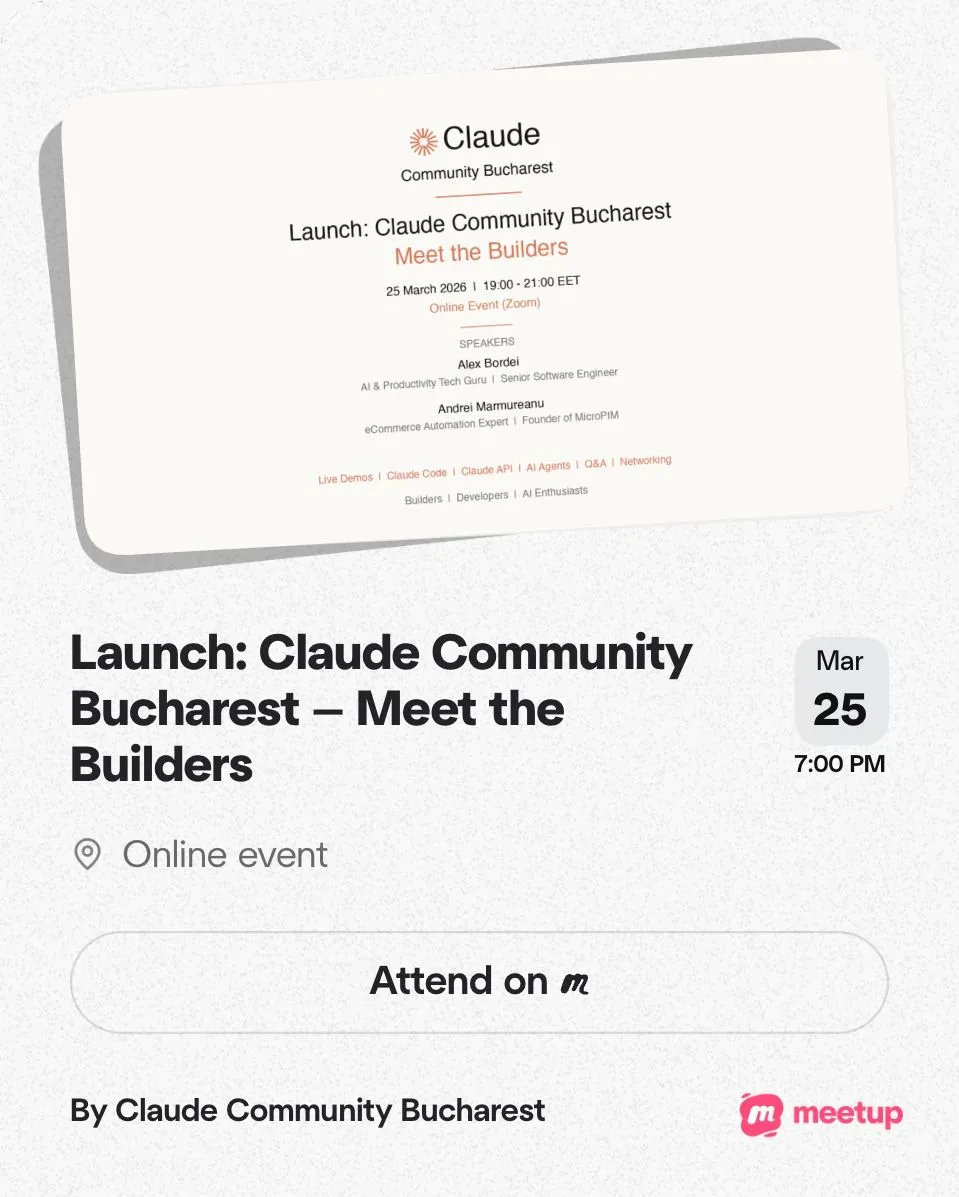
TL;DR — On 25 March 2026, Claude Community Bucharest launched with its inaugural Meet the Builders event. The community is a meeting point for the people who actually ship AI work in Romania: builders, developers, marketers, founders, and operators. This piece explains what Claude is, why it has become one of the most relevant AI platforms for serious work, and why the launch of this community matters for the regional ecosystem.
A new chapter for the Romanian AI ecosystem
Something quiet but important happened in Bucharest last week.
On the evening of 25 March 2026, a few hundred professionals tuned in to the launch of Claude Community Bucharest — the first dedicated, in-region community organised around Anthropic’s AI assistant, Claude. The inaugural session, titled Meet the Builders, was hosted online from 19:00 to 21:00 EET and featured two operators rather than the usual roster of pure-theory speakers: Alex Bordei, AI & productivity tech guru and senior software engineer, and Andrei Marmureanu, eCommerce automation expert and founder of MicroPIM.
The format said most of what you need to know about the intent: live demos, Claude Code, Claude API, AI agents, Q&A, and networking. No keynote-heavy choreography. No abstract slideware. Just builders showing other builders what is actually working — and which problems are still hard.
That tone is not accidental. Romania has world-class engineering talent, a sizeable population of marketers, founders, and operators who have already integrated generative AI into their day jobs, and a regulatory environment increasingly shaped by the EU AI Act. What has been missing — until now — is a focused, high-trust forum where the practitioners who use a single, serious AI platform compare notes.
Claude Community Bucharest is that forum.
What is Claude?
Claude is the AI assistant created by Anthropic. In practical terms, Claude is a conversational AI built on top of a family of large language models — currently in the Claude 4 line — that is optimised for reasoning, writing, analysis, coding, research, and enterprise productivity.
Where most consumer chatbots compete on personality and image generation, Claude has positioned itself around something different: reliable judgement on long, complex, real-world tasks. That positioning is the result of deliberate engineering choices.
- Human-centred AI philosophy. Claude is built to be useful, harmless, and honest. It is trained to push back politely when a request is ambiguous, to flag uncertainty rather than fabricate, and to keep humans in the loop on decisions that matter.
- Constitutional AI. Anthropic’s training methodology uses a written set of principles (a “constitution”) to shape Claude’s behaviour, rather than relying only on human raters. The result is a model that behaves more predictably under pressure.
- Long-context capabilities. Claude was an early leader in handling very long documents — entire books, multi-hour meeting transcripts, complete codebases — in a single conversation. That capability quietly changes the kind of work the model can do.
- Safety and reliability focus. For regulated industries — finance, legal, healthcare, public sector — predictability matters more than novelty. Claude is increasingly the default choice in those rooms.
A working definition: Claude is an AI assistant designed for serious, long-form work — the kind of work where being right matters more than being entertaining.
Who created Claude?
Claude is built by Anthropic, a San Francisco-based AI safety company founded in 2021 by Dario Amodei, Daniela Amodei, and a group of former senior researchers from OpenAI. The company’s stated mission is to ensure that the world safely makes the transition through transformative AI.
A few things make Anthropic structurally different in the global AI race:
- An alignment-first research culture. Anthropic has consistently invested in interpretability, evaluations, and constitutional methods — the unglamorous parts of AI research that make the difference between “impressive demo” and “trustable system”.
- A clear enterprise focus. While Anthropic ships consumer products, the centre of gravity is the enterprise: Fortune 500 deployments, public-sector partnerships, deep integrations with the major cloud platforms.
- Strategic distribution. Claude is available natively, through the Anthropic API, on Amazon Bedrock, Google Cloud Vertex AI, and through a growing list of partners. For most enterprises in Europe, Claude is one of the easiest frontier models to procure under existing cloud agreements.
That positioning matters for a Bucharest audience. The companies in this region that will ship AI at scale need a model that is enterprise-grade, EU-cloud-friendly, and predictable under audit. Claude fits that brief better than most.
Why Claude is unique
Frontier AI models converge in some ways and diverge in others. Asking “is Claude the best model?” misses the more useful question: for which tasks does Claude have a structural advantage today?
Based on a year of running Claude inside real client engagements, the honest list:
- Long-context reasoning. Feed Claude a 200-page acquisition memo, a multi-hour user-research transcript, or a full regulatory filing, and ask a precise question. The answer is usually grounded, with the right citations.
- Writing quality. Claude consistently produces prose that needs the least editing — a quiet but enormous advantage for content, legal, marketing, and executive-communication work.
- Strategic analysis. Asked to challenge an argument, identify hidden assumptions, or stress-test a plan, Claude reasons more like a senior analyst and less like a search engine.
- Coding. Claude Code, Anthropic’s terminal-based coding assistant, has become the daily driver of an entire cohort of senior engineers. Pair-programming with a model that can hold a whole codebase in context changes what one engineer can ship in a week.
- Document understanding. Claude is exceptional at extracting structured insight from messy real-world documents — invoices, contracts, transcripts, scanned PDFs — without the brittleness of older rule-based pipelines.
- Natural communication. The Claude tone is one of the model’s most undervalued strengths. It writes like a thoughtful colleague, not like a press release.
- Safety and reliability. Hallucinations exist in all frontier models, but Claude tends to acknowledge uncertainty earlier and refuse less hysterically. For regulated work, this is a major operational advantage.
One way to think about it: ChatGPT is the most popular AI; Gemini is the most integrated with Google; Copilot is the most enterprise-distributed; Claude is the one most often picked when the work has to be defensibly correct.
What can Claude be used for?
Here is where the abstract becomes concrete. A non-exhaustive map of where Claude is producing measurable productivity gains today.
Marketing teams
- Drafting briefs, articles, ad variations, and email sequences in a fraction of the usual time.
- Running competitive analysis across dozens of websites and reports in a single chat.
- Producing publication-quality first drafts that need light human polish, not full rewriting.
Sales teams
- Pre-call research on accounts and decision-makers.
- Drafting follow-ups the moment a call ends — with the next-step proposal already attached.
- Cleaning up and enriching CRM records from call transcripts.
Operations teams
- Generating SOPs from messy oral descriptions of how a process actually runs.
- Triaging vendor invoices, contracts, and tickets.
- Producing the dreaded weekly operations report in minutes, not afternoons.
Executives
- Pressure-testing a decision memo against the strongest possible counter-argument.
- Synthesising twenty industry reports into a single board-ready brief.
- Drafting internal communications that are clear, on-tone, and difficult to misread.
Analysts
- Combining quantitative data with qualitative transcripts into one coherent narrative.
- Running first-pass coding on user-research interviews.
- Generating hypotheses to test, not just summarising what is already known.
Students and lifelong learners
- Turning dense academic material into structured study notes and Socratic dialogues.
- Practising for interviews with a model that role-plays the toughest counterpart in the room.
Developers
- Pair-programming with Claude Code on real production codebases.
- Generating tests, refactoring legacy modules, drafting migrations.
- Designing and prototyping new agents and tool-use systems against the Claude API.
Customer support
- Drafting agent replies with the right help-centre articles cited inline.
- Summarising tickets and tagging sentiment automatically.
- Resolving most of the boring half of a support queue without ever waking a human.
Researchers and strategy teams
- Synthesising long literature reviews into structured, source-grounded summaries.
- Designing study protocols, screeners, and qualitative coding frameworks.
- Generating segment archetypes from interviews, then validating them against quantitative data.
The pattern that runs through all of these: Claude is most valuable on the work where context, judgement, and writing quality compound. It is the model you want when the output will be read by an executive, a regulator, or a customer.
How many interfaces does Claude have?
One of the underrated reasons Claude has become serious infrastructure is that it meets users where they already work. As of early 2026, the main interfaces are:
- Claude.ai (web app). The flagship consumer and pro interface. Conversations, Projects for grouping context, Artifacts for inline canvases, and a clean, distraction-light UX that many professionals prefer to its competitors.
- Claude mobile apps (iOS and Android). Same core chat, optimised for voice input, walking-and-thinking sessions, and quick captures.
- Claude Code. A terminal-based coding agent that pairs with your local codebase, runs commands, edits files, and ships pull requests under your supervision. It has become the daily tool of a growing share of senior engineers.
- Claude API. The developer surface for building Claude into applications, products, and internal tools. Access to the full model family — Opus, Sonnet, Haiku — plus features like prompt caching, batch processing, and Files.
- Claude for Teams and Claude for Enterprise. Shared workspaces, single sign-on, audit logs, role-based access, and tighter data-protection controls for organisations.
- Cloud integrations. Claude is available on Amazon Bedrock and Google Cloud Vertex AI, which means many EU enterprises can adopt it under their existing data-residency and procurement frameworks.
- The MCP ecosystem. Anthropic launched the Model Context Protocol in late 2024 as an open standard for connecting AI assistants to data sources, tools, and software. By 2026, MCP has become the de facto plumbing of the AI workspace: hundreds of servers connect Claude (and other clients) to GitHub, Notion, Linear, Google Drive, calendars, design tools, internal databases, CRMs, and more.
- Third-party integrations. A long tail of products — IDEs, productivity suites, design tools, vertical SaaS — embed Claude under the hood for specific workflows.
The distinction worth making: a model is the underlying capability, an interface is how you use it. Claude offers more interfaces than almost any other frontier model — which means there is almost certainly a surface that fits where you already do your work.
How much does Claude cost?
Pricing is the part of any AI article that ages fastest. Anthropic has iterated on pricing multiple times and will continue to do so. Pricing may evolve over time — always check the current page on anthropic.com or claude.com.
What is stable enough to be useful:
- Free tier. A capable consumer tier suitable for most individual exploration and daily lightweight use.
- Claude Pro. A paid individual plan with higher message limits, access to more advanced features, and priority during peak hours.
- Claude Team / Business. A small-team plan with shared workspaces, admin controls, and centralised billing.
- Claude Enterprise. Single sign-on, larger context windows, expanded usage, audit logging, custom data-protection terms, and procurement-friendly contracting.
- Claude API. Pay-as-you-go pricing based on input and output tokens, with significant discounts available through features like prompt caching and batch processing. For most production workloads, this is where Claude is consumed.
The strategic point is not “how much does it cost.” It is what does it pay back? A senior knowledge worker who saves five hours a week from disciplined AI use produces more value in two weeks than a year of Pro subscription. The companies still treating Claude as a per-seat expense are missing the calculation that matters.
Claude vs other AI models
Honest comparisons help. A short, opinionated view from inside real client work.
Claude vs ChatGPT
- Where ChatGPT leads: ecosystem breadth, voice mode, image generation, Sora-style video, the largest plugin and integration market.
- Where Claude leads: writing quality, long-document reasoning, refusal calibration (Claude says no less often when you actually need it to say yes), Claude Code, MCP-native developer experience.
- Choose ChatGPT when you need general-purpose AI across many media and a rich third-party plugin layer.
- Choose Claude when the output has to be defensibly correct, long-form, or land on an executive’s desk without rewriting.
Claude vs Gemini
- Where Gemini leads: deep integration with Google Workspace, image and video generation, native multimodality with audio and video, very competitive pricing on its lower tiers.
- Where Claude leads: reasoning consistency on long, ambiguous prompts; writing tone; coding agent UX; safety controls preferred by regulated enterprises.
- Choose Gemini when your org lives inside Google Workspace and you want AI inside Docs, Sheets, Meet, and Gmail by default.
- Choose Claude when you want a model-first product where the model itself is the differentiator.
Claude vs Copilot
- Where Copilot leads: Microsoft 365 integration (Word, Excel, PowerPoint, Outlook, Teams) and enterprise distribution. For a large share of the office-software world, Copilot is the easiest path to “AI is in everyone’s hands by Monday.”
- Where Claude leads: flexibility outside Microsoft’s surfaces, raw model quality on long-form reasoning, deeper customisation through the API.
- Choose Copilot when you want AI deeply embedded into Office and Teams without changing tools.
- Choose Claude when you want a frontier model you can deploy across surfaces — including bespoke internal tools and developer workflows.
The honest meta-take: the strongest AI organisations are running multi-model. Claude for long-form work and writing, ChatGPT for breadth and tool plugins, Gemini for Google-ecosystem retrieval, Copilot for Office distribution. The skill is no longer “which model” — it is which model for which job.
Why Claude matters for the future of work
Step back from the model wars for a moment.
The bigger story of 2026 is not the leaderboard. It is that AI has crossed the threshold from tool to collaborator. The teams that pulled ahead this year were not the ones with the most subscriptions. They were the ones that redesigned their workflows around AI — and made that redesign part of how the company thinks, hires, and operates.
A few patterns worth naming:
- AI-native workflows. The unit of work is no longer “person → artefact”. It is “person + AI → artefact”. The AI step is integrated into the daily flow, not bolted on as a separate ritual.
- Augmentation over replacement. The headline AI fear is automation. The reality on the ground is augmentation: senior people doing 1.5x the work, junior people climbing the learning curve faster, and entire job categories evolving rather than disappearing.
- Cognitive productivity. The real gain is not typing speed. It is less mental tax — fewer context switches, fewer half-remembered things, less cognitive overhead carried into evenings and weekends.
- AI collaboration as a skill. Knowing how to brief, challenge, and verify an AI’s work is becoming as core a workplace skill as writing emails was in the 2000s and using a spreadsheet was in the 1990s.
- The end of “AI as side project”. AI is no longer in the innovation department. It is in finance, legal, support, marketing, sales, ops, R&D, and HR — running in production, accountable for outcomes.
The big strategic shift: AI stopped being a tool you reach for and became a layer you work inside. The companies that internalise this in 2026 will look obviously ahead in 2027.
That is the world Claude Community Bucharest is built for.
Inside the launch of Claude Community Bucharest
The launch event was small on purpose. The internet does not need another room of broadcast monologues. It needs rooms where builders compare notes.
What that looked like on 25 March 2026:
- Live demos, not slideware. Claude Code rebuilding a small internal tool from scratch. A working AI agent automating a real eCommerce ops workflow. Examples that worked — and a few that did not, with the lessons attached.
- Two operator speakers. Alex Bordei brought the technical-productivity perspective from inside igodemy. Andrei Marmureanu, founder of MicroPIM, brought the eCommerce automation perspective from years of shipping retail-grade AI workflows.
- Q&A as the main act. Most of the value of an event like this is in the questions. The launch session deliberately reserved a long open block for back-and-forth between speakers and the room.
- Networking, on a regional scale. The attendees were not academic researchers — they were builders, founders, marketers, operators, and developers, mostly in or close to Bucharest, with an explicit invitation to teams across Romania, Moldova, and the wider region to join.
The ambition behind the community is broader than a monthly meetup. It is to build a high-trust, regional space for the people who are already shipping AI work, around three principles:
- AI literacy that holds up under audit. Not hype, not abstract demos — practical, repeatable, defensible AI workflows that survive contact with legal, security, and the customer.
- Builder energy, not pundit energy. The dominant voice in the room should be people who have shipped something this quarter, not people who tweet about AI for a living.
- Responsible adoption. The EU AI Act, GDPR, sector-specific rules — these are not enemies of AI adoption, they are constraints that make Romanian deployments more globally credible. The community treats responsible AI as a competitive advantage.
Why Bucharest? Because Romania already has the engineering talent, the operator density, and the customer-facing AI projects to be a meaningful node in the European AI map. What it has needed is a focused forum for the people doing the work. Claude Community Bucharest is that forum.
Future sessions on the roadmap (as previewed at the launch) include deep dives on Claude Code in production, building agents with the Claude API, MCP and the AI workspace, AI in marketing and customer research, and AI governance in regulated industries. Online by default, in-person as the calendar allows.
If you build with Claude — or want to — this is your room.
Conclusion: from tools to companions
The launch of Claude Community Bucharest is a small event in the global AI calendar. But small events compound.
A decade ago, the developer meetups that quietly grew into Romania’s mature engineering scene were not headline news either. They are the reason the country exports world-class software talent today. The same pattern is now playing out, one model layer up. The forums that take shape in 2026 around frontier AI platforms will shape the operators, founders, and senior managers who lead the next decade of enterprise work.
Claude is the right anchor for that conversation. It is increasingly the model picked by organisations whose AI deployments have to be right, not just impressive. And Bucharest is the right city for the conversation, because the talent, the operators, and the appetite are already here.
If you are building with AI, learning with AI, or rebuilding your team’s workflows around AI — the invitation is open. Join the next Claude Community Bucharest session. Show what you are shipping. Ask the hard question that has been bothering you. Meet the people who are an order of magnitude further along than you expected to find them.
The AI future of work is not happening somewhere else. It is happening, increasingly, here.
FAQ
What is Claude AI?
Claude AI is the AI assistant created by Anthropic. It is a conversational AI built on top of a family of large language models (Claude 4 line as of 2026) and is designed for reasoning, writing, analysis, coding, research, and enterprise productivity, with a strong focus on safety, reliability, and long-context understanding.
Is Claude free?
Yes, Claude has a free tier accessible via the Claude web app and mobile apps. Paid plans (Claude Pro for individuals, Team and Enterprise plans for organisations, and pay-as-you-go pricing on the Claude API) unlock higher usage limits, advanced features, and enterprise controls. Pricing may evolve over time.
What is Claude used for?
Claude is used for content creation, strategic analysis, research synthesis, coding, document understanding, customer support, sales enablement, operations automation, executive decision support, and any other knowledge-work task that benefits from a strong long-form, reasoning-capable AI assistant.
How does Claude compare to ChatGPT?
ChatGPT typically leads on ecosystem breadth, plugin marketplace, and multimodal media generation. Claude typically leads on long-document reasoning, writing quality, coding workflows (via Claude Code), and predictability under regulated, enterprise use. Most serious AI organisations now run both, choosing model-by-task.
How many interfaces does Claude have?
Claude is available through the Claude web app (claude.ai), Claude mobile apps (iOS and Android), Claude Code (terminal coding agent), Claude API (developer access), Claude Team and Enterprise workspaces, cloud distributions on Amazon Bedrock and Google Cloud Vertex AI, the MCP-driven third-party ecosystem, and many embedded integrations.
Is Claude good for business?
Yes. Claude is one of the leading AI platforms for enterprise use, with strong long-context reasoning, mature data-protection controls, single sign-on, audit logging, and availability on the major EU-friendly cloud platforms. It is increasingly the default choice in regulated industries.
What makes Claude unique?
Claude’s distinctive features are its constitutional AI training, long-context capabilities (very large documents in one conversation), writing quality, predictable refusal behaviour, safety focus, and the Claude Code + MCP developer ecosystem — all of which combine into a model that is unusually well suited to defensible, long-form, real-world work.
What is Claude Community Bucharest?
Claude Community Bucharest is a regional community for the builders, developers, marketers, founders, and operators working with Claude AI and the broader Anthropic ecosystem. Launched on 25 March 2026 with an inaugural Meet the Builders session, the community runs live demos, technical deep-dives, Q&A, and networking — online by default, with in-person sessions on the roadmap.
How do I join Claude Community Bucharest?
You can find and RSVP to upcoming Claude Community Bucharest events on Meetup. Sessions are open to anyone working with — or seriously considering — Claude AI in their company or product.
Want to bring the same practical AI thinking into your team? Talk to igodemy about our enterprise AI training program — or download the brochure for the full curriculum.